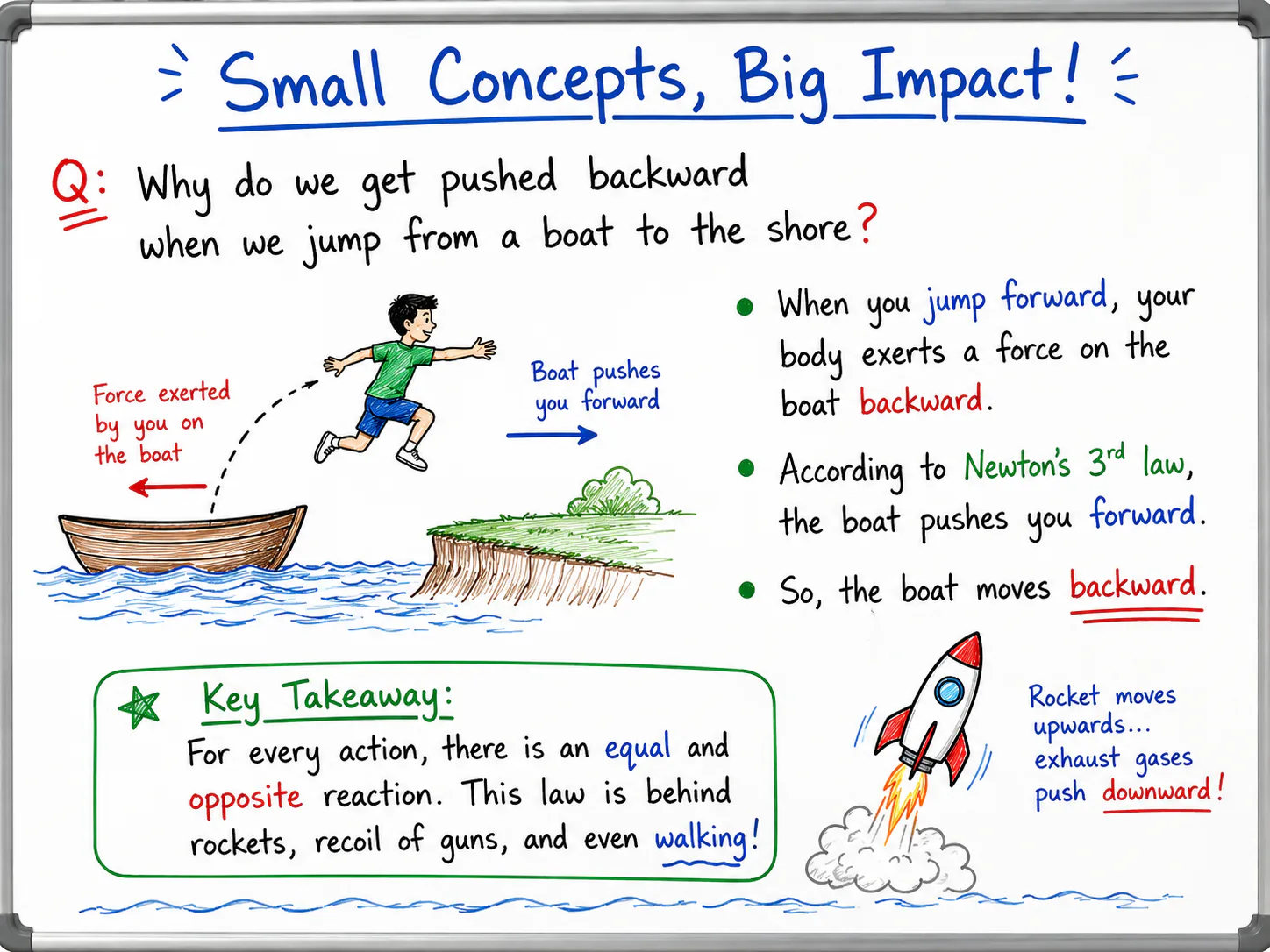
What happens during the jump?
To move towards the shore, your feet push backward against the boat. The boat responds by pushing you forward. Because the boat is floating and can move freely, your backward push makes it slide away from the shore.
The forces appear together: you exert a force on the boat, and the boat exerts a force of equal size in the opposite direction on you.
Newton's third law
Newton's third law says that when one object exerts a force on another object, the second object exerts an equal and opposite force on the first.
These forces do not cancel each other because they act on different objects. One force acts on the boat, while the other acts on the person jumping.
Why is the boat's movement noticeable?
A small boat has much less mass than the ground beneath your feet, so the force from your jump produces a noticeable change in its motion. A heavier boat would usually move less under the same push.
Where else can we see this law?
- Walking: your foot pushes the ground backward, and the ground pushes you forward.
- Swimming: you push water backward, and the water pushes your body forward.
- Rockets: exhaust gases are pushed downward, producing an upward force on the rocket.
- An untied balloon: air rushes out in one direction while the balloon moves in the other.